Elenthikkara, Chendamangalam, Puthenvelikara, Kerala crcputhenvelikkara@gmail.com
Follow us:

Equinoct, Kochi

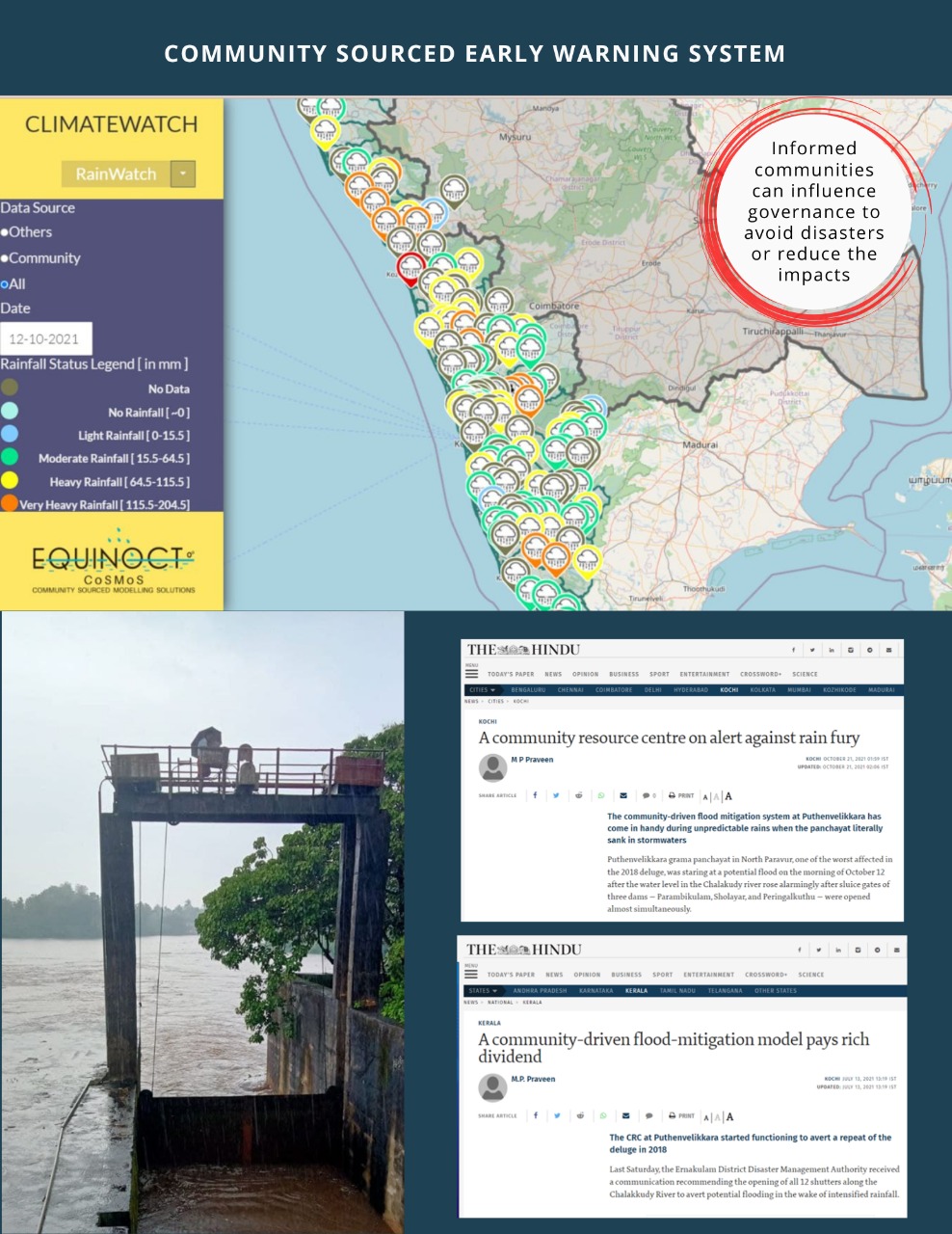
EQUINOCT provides science-based solutions for addressing the impacts of climate change, working with communities, institutions and governments. We are working towards a climate resilient future.

EQUINOCT sources its questions, inputs and insights partnering with communities and working with institutions and government towards building a climate-resilient society
M.S. Swaminathan Research Foundation, Chennai

The M.S. Swaminathan Research Foundation (MSSRF), founded in 1988 by Professor M.S. Swaminathan, stands as a global leader in leveraging science and technology for sustainable rural development. Established with the proceeds of the First World Food Prize, MSSRF embodies the visionary ethos of its founder, who transformed the landscape of food security and ecological sustainability.

Guided by a pro-poor, pro-woman, and pro-nature approach, the Foundation addresses critical community challenges through holistic, interdisciplinary research and by integrating traditional knowledge with cutting-edge scientific advancements. Rooted in participatory models, MSSRF partners with local communities, public and private sectors, and academic institutions to work towards solutions that are inclusive, scalable, and impactful.
SNM Institute of Management and Technology, Ernakulam

SNM Institute of Management and Technology is one of the most prestigious and earliest self financing engineering colleges in Kerala. This Institute is owned and managed by the Hindu Matha Dharma Paripalana Sabha (HMDP Sabha, Moothakunnam), which was established in 1882, under the guidance of Sri Venkatagiri Sasthrikal, an Andhrite theologist, who pioneered Hindu Maha Parishath movement. Motivated by the teachings of the great social reformer, Sree Narayana Guru, a number of educational Institutions were established by the sabha.

SNM Institute of Management and Technology was established in the year of 2002 on the campus at Maliankara, and it is the latest jewel in the crown of HMDP Sabha. The college is situated in Ernakulam district, at Maliankara, a village, 3 KM away from NH-17, between N.Paravur and Kodugallur. It is spread over a sprawling area of 45 acres in a serene atmosphere with ever green coconut palms and surrounded by backwaters and the Arabian Sea. SNMIMT, Maliankara is by far the great forerunner in the field of Technology and Management in Kerala by virtue of the innovative approach in the curriculum transaction. This educational institution is housed in an imposing structure of more than one lakh seventy thousand square feet, set in a typical rural ambience of the fishing village that is Maliankara, surrounded by back waters and the Arabian Sea in the west.

Though essentially rural, it is urban in instructional and infrastructural facilities with the calmness and serenity that encompasses the college campus, one could only be fascinated and impressed beyond measure. If you are lucky to be in, you will only be inspired to do more, and motivated to engage yourself in furthering your area of specialization and you do learn by doing and experience will linger and be a part of you all your life. You know the saying, The college is recognized by AICTE and affiliated to Mahatma Gandhi University, Kottayam and APJ Abdul Kalam Technological University (KTU). It offers B.Tech programe in Electronics and Communication Engineering, Electrical and Electronics Engineering, Computer Science and Engineering, Instrumentation and Control Engineering,Mechanical Engineering and Civil Engineering with a total intake of 420 regular and 42 lateral entry (Diploma Holders) students in the second year bringing the total to 462 students.
Mental Health Action Trust , Kozhikode

MHAT is a Charitable Trust, based in Kozhikode, Kerala, India and provides good quality, comprehensive and recovery oriented mental health care to the poorest sections of the population with severe mental disorders. It is entirely based in the community with no provision for hospital admissions and people being selected based on a process of economic screening. The service is provided in collaboration with like-minded local partners which makes it possible to offer services free to the end user

SOPPECOM, Pune

The Forum beginning was an unforeseen one. The World Wide Fund for Nature (WWF) in November 2004 organised a meeting for water sector professionals in Bangalore, to discuss a draft publication of 20 case studies on water conflicts from peninsular India. This documentation was done as part of WWF’s freshwater initiative ‘Dialogue on Food, Water and Environment’ by ‘Pragathi – Farmer’s Society for Rural Studies and Development’ and supported by WWF. The case studies were primarily authored by R. Doraiswamy and Biksham Gujja, who represented Pragathi and WWF respectively. This meeting brought about some realisations, that there were many more conflicts of varied nature undocumented and the information on the few documented conflicts was unorganised. While earlier modes of inquiry were built around water issues and movements to address these issues, the viewing of these case studies from the perspective of conflicts rather than simply as water issues was the contribution of Biksham Gujja. These realisations drove the participants of this meeting to decide to form the Forum for Policy Dialogue on Water Conflicts in India. One thing that came to the forefront early on was the fact that very little was understood about smaller water conflicts happening across the country, because public discussions are often limited to the bigger, more well-known, inter-state water conflicts (e.g. Cauvery, Krishna). The realisation that the true geographic and typological spread of water conflicts was not being captured became apparent. Discussions brought to light the occurring contestations and contradictions, lack of knowledge based decisions, political pressures surrounding water and the lack of consultation of the stakeholders in the decision making. What was needed were organisations to engage with these issues from a conflicts perspective. The aim of this initial dialogue was not to develop tools to resolve water conflicts but merely to understand them better, initiate a national dialogue and then lobby for better policy. This would involve studying water conflicts by the nature of conflict, investigating relevant data, policies, laws and socio-economic information for context and understanding reasons that drove conflicts. A decision was taken to come out with a larger document with more case studies that would engage with the issues raised. Out of these discussions, the Forum was born. The next step was to nurture this idea into reality. This required setting up an institution to run the activities, funding, setting up a process to write the case studies and publish it. A Steering Group was therefore nominated to guide the publication. It was decided that this work of documenting water conflicts would largely cover case studies of peninsular India because that is where the strength of the initial group lay. It would also attempt to capture the range of typologies of water conflicts occurring in different parts of the country. Thought was also given to institutionalise the Forum, but the consensus was against this, since that would require a firm commitment from core people, academics and faculty and also resources of a different magnitude. The arrangement of a network (individuals and organisations) housed in an already existing organisation working on water issues instead, would be more flexible. In the course of time, the Society for Promoting Participative Ecosystem Management (SOPPECOM), an organisation based in Pune, was requested to coordinate the workings of a formal network to prepare a project proposal, secure the required funding and take forward this effort. The first set of resources to the Forum was made available by the WWF and people from different states took up roles of coordination. An official Steering Committee was also formed to take decisions for the Forum, consisting of Bhaskar Rao, K.V. Rao, R. Doraiswamy, Rakesh Tiwary, Srinivas Mudrakartha, Ganesh Pangare, Uma Maheshwari, S.K. Anwar, Malavika Chauhan, Biksham Gujja, N.J. Rao, A. Latha, Vinod Goud and K. J. Joy. This was the beginning of the First Phase of the Forum’s work.